






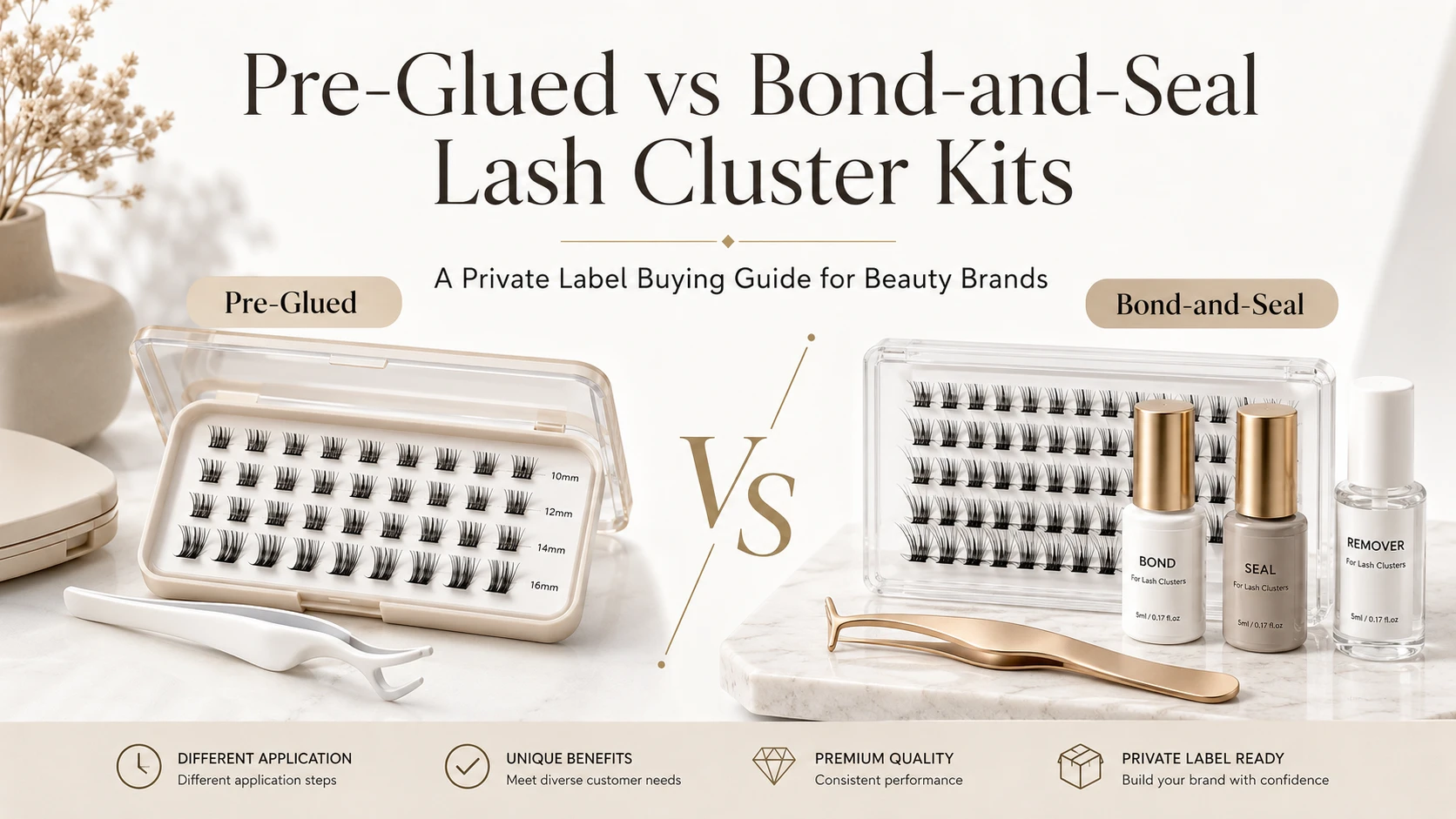
La elección entre extensiones de pestañas preencoladas y un sistema de fijación con adhesivo influye en el público objetivo, el proceso de aplicación, el modelo de fidelización, el riesgo de reclamaciones y las especificaciones del proveedor. Para las marcas de belleza, el kit de extensiones de pestañas de marca propia ideal depende de si la promesa del producto se centra en una aplicación simplificada o en una rutina completa de pestañas para hacer en casa. Esta decisión debe tomarse antes de aprobar el empaque, las afirmaciones de marketing o una amplia gama de productos.
¿Preencoladas o con adhesivo termofusible? ¿Qué kit de pestañas postizas debería elegir una marca?
Las extensiones de pestañas preencoladas suelen ser ideales para clientes que priorizan la comodidad y desean un proceso de aplicación más sencillo. Un kit de extensiones de pestañas con adhesivo integrado es más apropiado cuando una marca desea vender un sistema completo que incluya extensiones, productos de aplicación, herramientas y posibles recambios.
La elección correcta depende de la experiencia del cliente, el canal de ventas, la posición de precios y la cantidad de información sobre el producto que la marca pueda proporcionar.
|
Factor de compra |
Grupos de pestañas preencoladas |
Grupos de pestañas con sistema de unión y sellado |
|
Propuesta principal |
Aplicación simplificada |
Rutina controlada de varios pasos |
|
Kit típico |
Clústeres y aplicador |
Grupos, adhesivo, sellador, aplicador, removedor opcional |
|
Curva de aprendizaje |
Generalmente más bajo |
Generalmente más alto |
|
Complejidad de SKU |
Más bajo |
Más alto |
|
Oportunidades de recarga |
Recargas de clúster |
Recambios para racimos, adhesivos, selladores y removedores. |
|
Principal riesgo de aprovisionamiento |
Estabilidad del adhesivo preaplicado |
Compatibilidad entre componentes |
Las marcas que venden a través de marketplaces, demostraciones en redes sociales o tiendas minoristas centradas en la conveniencia pueden preferir los productos preencolados porque el concepto de aplicación es más fácil de comunicar. Las marcas que desarrollan un kit de extensiones de pestañas de marca propia más amplio para uso doméstico pueden preferir los adhesivos y selladores porque son compatibles con kits de inicio, grupos de repuesto y recambios consumibles.
Normalmente, una nueva marca de belleza debería validar un formato antes de introducir muchas longitudes, densidades, curvaturas y diseños de pestañas.
¿En qué se diferencian los sistemas de pestañas preencoladas y los sistemas de unión y sellado?
Aunque el aspecto final pueda ser similar, ambos sistemas generan requisitos diferentes en cuanto a abastecimiento y control de calidad. Los compradores deben evaluar la experiencia completa del cliente, en lugar de juzgar las muestras únicamente por su suavidad o el aspecto de la bandeja.
Pestañas preencoladas en grupos: aplicaciones y limitaciones
Las extensiones de pestañas preencoladas, a veces descritas como autoadhesivas, llevan el material de fijación en la base. Son ideales para quienes priorizan una aplicación rápida y no desean manipular un adhesivo por separado.
Este formato puede resultar menos adecuado cuando el posicionamiento de una marca depende de la aplicación de adhesivos ajustables, de un proceso más largo con varios pasos o de una amplia gama de consumibles.
Durante la revisión de las muestras, los compradores deben comprobar que los racimos se desprendan limpiamente de la bandeja, conserven su forma, permitan un reposicionamiento adecuado y mantengan un rendimiento constante tras el envasado. El proveedor debe aclarar las instrucciones de almacenamiento, los requisitos de sellado del envase, la información sobre la vida útil y las condiciones que puedan afectar al adhesivo preaplicado.
La dificultad para recoger el producto, la adherencia inconsistente, la deformación del adhesivo y los cambios en el rendimiento tras el transporte constituyen riesgos importantes en la adquisición. Por lo tanto, las pruebas deben realizarse con muestras empaquetadas, no solo con prototipos sueltos.
Kits de unión y sellado: Componentes y riesgos de compatibilidad
Un kit de pestañas de marca blanca con adhesivo y sellador es un sistema de producto completo. Un kit básico puede contener mechones de pestañas, adhesivo, sellador y un aplicador. Una versión más completa puede incluir removedor, instrucciones o productos de repuesto.
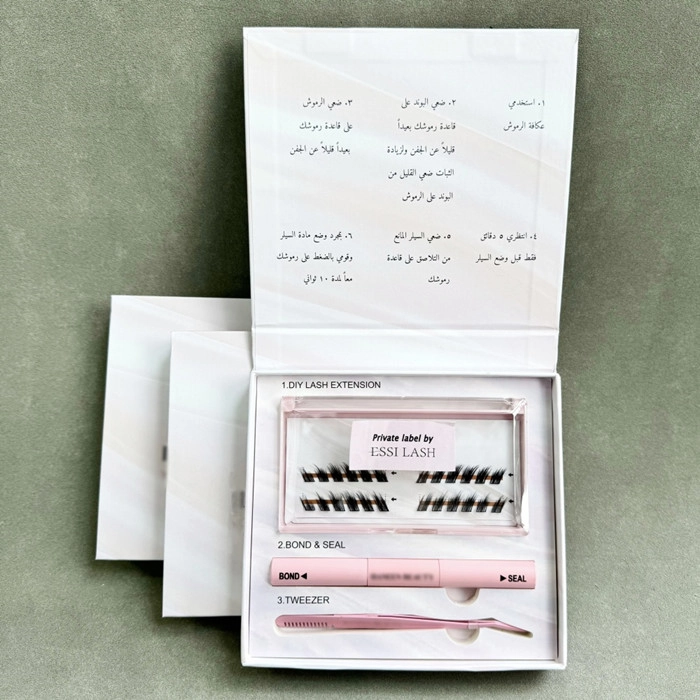
Este formato es ideal para marcas que desean informar a sus clientes sobre el orden de aplicación, la cantidad de adhesivo, el sellado y la remoción. Sin embargo, puede resultar menos adecuado para quienes buscan un producto de un solo paso.
La forma de la base del clúster, la textura del adhesivo, la aplicación del sellador, la geometría del aplicador y el rendimiento del removedor deben funcionar en conjunto. Componentes que individualmente son aceptables pueden, sin embargo, generar desprendimiento, deslizamiento, residuos o dificultad en la remoción cuando se combinan.
Los compradores deben solicitar muestras del sistema completo que contengan los componentes exactos destinados a la producción. Las afirmaciones sobre resistencia al desgaste, impermeabilidad, sensibilidad y facilidad de extracción deben verificarse con la documentación del producto y los requisitos del mercado de destino, en lugar de basarse en una fórmula genérica.
¿Cuáles son las causas de las quejas y devoluciones de los kits de pestañas postizas?
Las quejas evitables suelen deberse a una falta de coherencia entre el diseño del producto, el embalaje, las instrucciones y las expectativas del cliente. Un kit puede promocionarse como apto para principiantes, pero utilizar una base difícil de sujetar o un adhesivo que requiere una aplicación precisa.
Fallo del adhesivo, desprendimiento y residuos pegajosos.
En el caso de productos preencolados, la baja adherencia o el desprendimiento de los bordes pueden estar relacionados con el material adhesivo, las condiciones de almacenamiento, el diseño de la bandeja o la superficie de aplicación.
En el caso de los kits de unión y sellado, la adherencia excesiva o la presencia de residuos pueden deberse a componentes incompatibles, a un exceso de adhesivo, a un sellado insuficiente o a un proceso de eliminación inadecuado.
Las pruebas de muestra deben registrar:
- Recogida y posicionamiento del clúster
- Adhesión inicial
- Capacidad de reposicionamiento
- Elevación de bordes
- Comodidad durante el uso
- Residuo después de la extracción
- Estado del grupo después de la extracción
Las pruebas deben realizarse siguiendo las instrucciones proporcionadas al cliente. Esto ayuda a determinar si el problema se debe al producto, a las instrucciones o a expectativas de marketing poco realistas.
Si los resultados varían significativamente, el siguiente paso debería ser revisar el adhesivo, la base del clúster, el embalaje o las instrucciones, y no pasar directamente a la producción en masa.
Comodidad de la banda, peso de las pestañas y desajuste de estilo
Un conjunto de pestañas con un aspecto llamativo no es automáticamente adecuado para un kit básico. El grosor de la base, el ancho del conjunto, el peso, la densidad, la curvatura y el diseño de las pestañas influyen en la recogida, la colocación, la comodidad y el aspecto.
Los principiantes pueden beneficiarse de una base manejable y una gama limitada de estilos claramente diferenciados. Los usuarios más experimentados que se aplican las pestañas por sí mismos pueden aceptar densidades mayores o diseños de pestañas más complejos.
Los compradores deben comparar la forma de la base, la consistencia del rizo, la separación entre los grupos, la uniformidad izquierda-derecha y la deformación durante la recogida. Un grupo de muestra específico que incluya opciones naturales, finas y más densas suele ser más útil que seleccionar un catálogo extenso sin realizar pruebas.
Un posicionamiento incorrecto del estilo puede generar tanto quejas de los clientes como una baja rotación del inventario.
¿Qué formato de kit se ajusta mejor al cliente objetivo y al modelo de negocio?
Los clientes que priorizan la comodidad suelen valorar la sencillez, las demostraciones claras y el empaquetado compacto. Los usuarios que prefieren el bricolaje y el uso de sistemas pueden aceptar un proceso más largo a cambio de mayor control y una experiencia completa con el kit.
Un kit de pestañas preencoladas puede lanzarse con una cantidad limitada de estilos. Una gama de adhesivos y selladores puede ofrecer un kit de inicio con recambios de adhesivos, selladores o removedores, pero también genera mayores riesgos de predicción y compatibilidad.
Un rango inicial manejable puede incluir:
- Un kit básico
- Un kit estándar
- Una gama limitada de recambios para grupos
- Solo los accesorios necesarios para el sistema seleccionado.
Se pueden introducir rizos, densidades, longitudes y diseños de pestañas adicionales una vez que los datos de ventas identifiquen una demanda constante.
Las marcas también deben determinar si cada componente es un producto básico, una mejora opcional o una futura extensión de producto. Añadir todos los accesorios posibles al lanzamiento inicial puede aumentar los costos de empaque y complicar el inventario sin mejorar la experiencia del cliente.
¿Qué especificaciones deben confirmar los compradores antes de solicitar muestras?
Una solicitud de “un kit de clúster natural” no es lo suficientemente detallada para un muestreo o una cotización precisos. Una solicitud de cotización útil debe definir el cliente objetivo, el formato de aplicación, los componentes, la dirección de estilo, el embalaje y la cantidad estimada.
Para las pestañas, confirme:
- Descripción del material o fibra
- Acabar
- Diseño y ancho de la base del clúster
- Rango de longitud
- Curl
- Densidad
- Mapa de pestañas
- Recuento de clústeres
- Disposición de la bandeja
En el caso de los grupos de pestañas preencoladas, confirme también el comportamiento de recogida, la protección del embalaje, la información de almacenamiento y la documentación relacionada con el adhesivo.
Para un kit de adhesivo y sellado, enumere todos los componentes, el formato del paquete, el tipo de aplicador, el removedor opcional, las instrucciones y el plan de recarga. Los compradores no deben asumir que un adhesivo, un sellador o un removedor son compatibles simplemente porque cada artículo se vende por separado.
Los requisitos de embalaje deben abarcar la estructura de la caja, el folleto informativo, la retención de componentes, la identificación del lote, las instrucciones, las advertencias, las indicaciones de almacenamiento y el diseño gráfico.
Las afirmaciones también requieren revisión. La Administración de Alimentos y Medicamentos de EE. UU. (FDA) establece que el etiquetado de los cosméticos debe ser veraz y no engañoso, y que ciertas afirmaciones pueden influir en la regulación del producto. Se deben consultar los requisitos para cada mercado de destino.
¿Cómo deberían las marcas de belleza probar las muestras antes de la producción en masa?
Las pruebas deben realizarse con la bandeja, las herramientas, las instrucciones y el empaque finales o casi finales. Una sola prueba informal no es suficiente para aprobar un kit de pestañas postizas de marca propia.
El plan de pruebas debe abarcar:
- Recogida y liberación de la bandeja
- Colocación y reposicionamiento
- Adhesión inicial
- Elevación de bordes
- Comodidad
- Eliminación
- Residuos de adhesivo
- Deformación del cúmulo
- Usabilidad del aplicador
- Estado del embalaje
Los componentes adhesivos deben probarse como un sistema único. Los productos preencolados deben evaluarse después de haber soportado las condiciones de almacenamiento y manipulación especificadas para la muestra.
La versión aprobada debe conservarse como muestra de referencia. Posteriormente, se pueden comparar las muestras de producción y las unidades del pedido piloto con esta para verificar la integridad de los componentes, la coherencia del estilo, el estado del embalaje y los defectos definidos.
Las condiciones de compra también deben explicar cómo se gestionarán las piezas faltantes, los embalajes dañados, las variaciones inaceptables o los productos defectuosos.
Cómo elegir un proveedor de kits de pestañas de marca propia
Un proveedor adecuado debería poder hablar sobre la configuración del kit, el abastecimiento de componentes, la personalización, el embalaje, las muestras, la comunicación de producción y el manejo de defectos, no solo sobre las pestañas.
Los compradores deben preguntar si el proveedor puede ofrecer un kit completo de extensiones de pestañas personalizadas y si dispone del formato preencolado o de unión y sellado que se requiere. El proveedor también debe explicar qué especificaciones o componentes tienen cantidades mínimas de pedido específicas.
Confirme si se aplica el MOQ mediante:
- Estilo de pestañas
- Diseño de envases
- Componente individual
- Kit completo
- Obras de arte personalizadas
Las muestras de producto, las muestras de envases de marca, las muestras de preproducción y los plazos de entrega a granel deben tratarse por separado.
Una solicitud de cotización clara debe incluir el mercado objetivo, el formato del kit, las referencias de estilo, las especificaciones del clúster, la lista de componentes, el concepto de empaque, la cantidad estimada y la documentación requerida. La dificultad para explicar cómo funcionan los componentes en conjunto puede indicar un mayor riesgo para un producto basado en un sistema.
Soporte para kits de pestañas de marca propia de ESSI LASH
Productos para pestañas ESSI LASH y soluciones de marca blanca Incluye extensiones de pestañas, herramientas relacionadas, accesorios y opciones de empaque. La amplia gama de productos de la empresa permite a los compradores analizar conjuntos de pestañas, pinzas, removedores y otros componentes del kit dentro de un mismo proyecto de abastecimiento.
Una publicación Kit de pestañas en racimo de marca privada personalizado Este estuche incluye un kit personalizado con adhesivo y sellador 2 en 1 seleccionable, pinzas, removedor, estilos de racimos personalizados y opciones de caja personalizadas. Esta aplicación es diferente a un kit de iniciación profesional para extensiones de pestañas y está más orientada a un proyecto de bricolaje para el consumidor.
Compañía de Productos de Belleza ESSI de Qingdao, Ltd. Se identifica como un proveedor de Qingdao especializado en pestañas, accesorios para pestañas y empaques de marca blanca. Su información de servicios incluye impresión de logotipos, personalización de empaques, muestras mixtas, desarrollo de pestañas personalizadas y dropshipping. Antes de realizar un pedido, cada proyecto debe confirmar las especificaciones exactas del producto, la documentación, la cantidad mínima de pedido (MOQ), los requisitos de empaque y el proceso de muestreo.
Conclusión
Los kits de pestañas preencoladas y los kits de unión y sellado están diseñados para diferentes usuarios y conllevan distintos riesgos de adquisición. Los productos preencolados facilitan una aplicación más sencilla, mientras que los kits de unión y sellado permiten un sistema de productos y un modelo de recarga más amplios.
La decisión de compra debe basarse en el cliente objetivo, la compatibilidad de los componentes, el embalaje, los resultados de las muestras, las afirmaciones y una planificación rigurosa de las referencias de productos (SKU), y no únicamente en el atractivo de las tendencias.
Los compradores pueden Solicita una muestra del kit de extensiones de pestañas y un presupuesto. Al enviar el formato previsto, las referencias de estilo, las especificaciones de las pestañas, la lista de componentes, el concepto de empaque, la cantidad objetivo, el mercado de destino y la documentación requerida, se podrá evaluar con mayor precisión la presentación de las muestras y las opciones comerciales.
Preguntas frecuentes
¿Son las pestañas preencoladas adecuadas para principiantes?
Pueden ser adecuados para clientes que prefieren menos pasos de aplicación, pero su idoneidad depende de la facilidad de recogida, el reposicionamiento, la estabilidad del adhesivo, las instrucciones y el uso previsto. Se recomienda probar las muestras empaquetadas con usuarios representativos antes de promocionar el producto como apto para principiantes.
¿Qué debería incluir un kit de pestañas de marca propia para unir y sellar?
Un kit básico puede incluir conectores, adhesivo, sellador y un aplicador. Se pueden añadir removedor, instrucciones y productos de recarga cuando se ajusten a la experiencia del cliente y al precio. Cada componente debe probarse como parte del sistema completo.
¿Cómo puede un comprador probar muestras de extensiones de pestañas antes de realizar un pedido al por mayor?
Evaluar la recogida, la colocación, la adhesión, el levantamiento, la comodidad, la eliminación, los residuos, la deformación del cúmulo, la facilidad de uso del aplicador y el embalaje. Comparar las unidades de preproducción y de pedido piloto con una muestra de referencia aprobada.
¿Qué información debe incluirse en una solicitud de cotización para un kit de extensiones de pestañas?
Incluya el formato del kit, el usuario objetivo, las referencias de estilo, la descripción del material, el diseño base, las longitudes, los rizos, la densidad, el número de grupos, los componentes, el embalaje, la cantidad, el mercado de destino y los requisitos de documentación.
¿Puede una marca de belleza lanzar al mismo tiempo kits preencolados y kits para unir y sellar?
Sí, pero hacerlo aumenta la complejidad en cuanto a referencias de productos, empaquetado, formación del cliente e inventario. Un lanzamiento por fases suele ser más fácil de evaluar, a menos que los datos de demanda existentes ya respalden ambos sistemas.

 English
  Spanish